

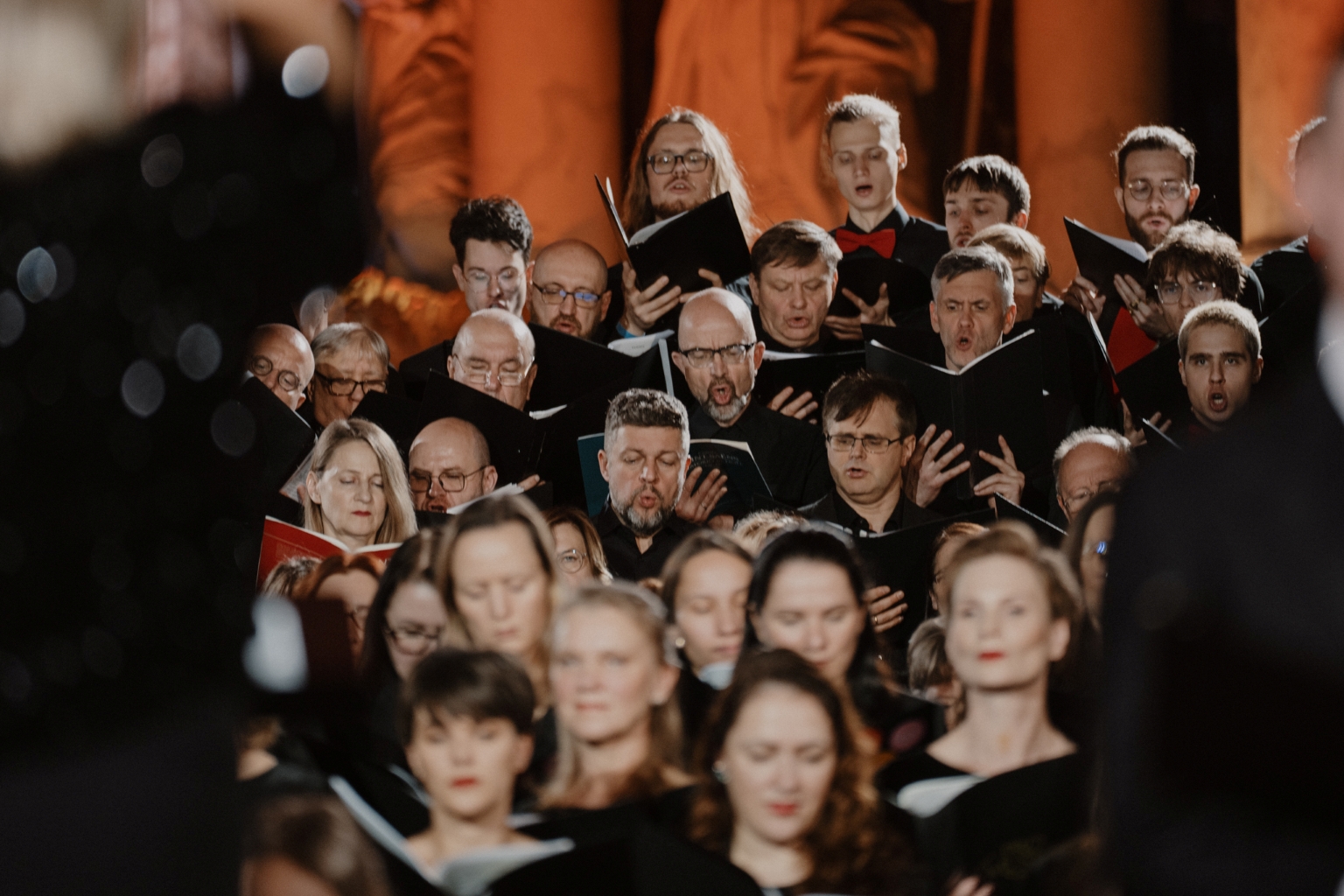
The VU Joint Choir performed with the world-renowned pianist Mūza Rubackytė at the closing concert of the first “EuroLiszt” festival at Paliesius Manor. At the event held on Sunday, October 18, at 4 p.m., a large group of musicians performed “Via Crucis” by the famous Hungarian composer Ferenc Liszt.
The festival’s final concert, dedicated to Ferenc Liszt, pianist, composer and one of the most important figures of 19th-century European culture, featured the festival’s artistic director and originator, Mūza Rubackytė, a performer always awaited and beloved in Lithuania. She was joined by the VU Joint Choir (artistic director Rasa Gelgotienė), made up of members of the choirs “Pro musica,” “Virgo” and “Gaudeamus,” and by soloists who are master’s students of the Solo Singing Department of the LMTA (Lithuanian Academy of Music and Theatre): Gabrielė Andrulytė (soprano), Vakarė Banuškevičiūtė (mezzo-soprano), Ignas Ščesnulevičius (tenor) and Ervinas Jasevičius (bass). Rasa Gelgotienė conducted.
Liszt’s “Via Crucis,” or “The Way of the Cross,” is a unique work full of fragile subtlety and deep drama, consisting of 14 parts corresponding to the Stations of the Cross. Each is distinctive, with its own musical character, and together they span a broad expressive range from quiet prayer to dramatic climaxes, helping listeners contemplate Christ’s suffering and enter into deeper reflection.
“For our choir, it is not only a great honor to perform with the world-renowned pianist Mūza, but also an invaluable school of interpreting Romantic music. Both the choristers and I myself simply drink in her ability to give deep meaning to every, even the slightest, musical phrase,” said Rasa Gelgotienė, artistic director and principal conductor of the VU choirs.
Liszt’s “Via Crucis” was first performed in Lithuania in April 2025 at St. Johns’ Church in Vilnius. The VU Joint Choir prepared for it with particular care: before the concert, it had the opportunity to rehearse with Mūza Rubackytė. Later, at Easter of the same year, the work was presented by the same ensemble to the audience of a festival held at the historic Compiègne Castle in France.
Paliesius Manor was therefore not chosen for the Lithuanian festival by chance. In the 19th century, manors and salons were important spaces of European musical life, where a concert became not only a musical but also a social and spiritual experience. It was in such surroundings that Liszt spent the golden period of his touring, performing for monarchs, aristocracy and European intellectuals. The festival seeks to revive this tradition at Paliesius Manor by restoring the close relationship between performer and listener and turning the manor into a living space of international culture.
Pianist Mūza Rubackytė is one of the most important ambassadors of Lithuanian musical culture in the world. Interpretations of the Hungarian composer Ferenc Liszt hold a special place in her work. Critics of the American publication “Fanfare” have called her “one of the best living Liszt performers.” Rubackytė is a member of the Bureau of the International Liszt Associations (ILA), president of the composer’s society in Lithuania, “Lisztuania,” and the initiator and patron of the pianists’ competition “Lisztofonija.” In 2012, the Hungarian Ministry of Culture awarded Rubackytė the “Pro Hungarica” prize for promoting Liszt’s work around the world.
The VU choirs “Gaudeamus,” “Pro musica” and “Virgo” are three exceptional ensembles that unite different voices and experiences into a single musical community. Each choir has its own unique history and identity, but their shared goal is to cherish choral music and spread its beauty both in Lithuania and abroad. The joint activity of these three choirs not only strengthens the musical potential of each ensemble but also creates a unique synergy that allows them to present choral music of the highest level to listeners.
Text by Algirdas Venckus